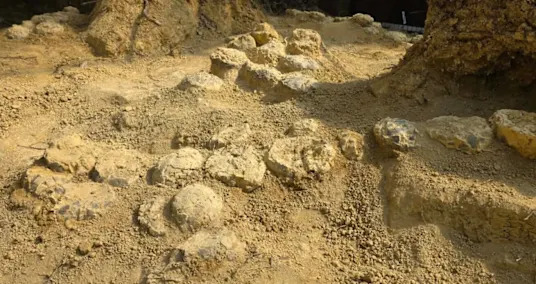
Imagine brushing away 72 million years of sediment and uncovering hundreds of dinosaur eggs, their shells still intact after surviving everything from asteroid impacts to ice ages. That’s exactly what happened at the Mèze fossil site in southern France, where paleontologists working through the winter months revealed one of the world’s most significant dinosaur nesting grounds. The discovery feels like stumbling upon a prehistoric treasure trove—if ancient titanosaurs had curated their own museum exhibits.
Ancient Nursery Preserved in Stone
Museum director calls the find an unprecedented gathering of fossilized eggs.
Alain Cabot, director-curator of the Musée-Parc des Dinosaures de Mèze, described the discovery as an “exceptional concentration” spanning 15 square miles of Upper Cretaceous rock. Over 100 eggs became visible within weeks of careful excavation, with many retaining their internal structures—a paleontologist’s equivalent of finding unopened time capsules. The fossil-rich layer extends far beyond the current dig site, suggesting this ancient maternity ward holds many more secrets waiting 70-72 million years for their moment in the spotlight.
A Snapshot of Cretaceous Family Life
Titanosaurs dominated the nesting ground, but smaller dinosaurs also called it home.
The eggs primarily belong to titanosaurs—those massive long-necked herbivores that would dwarf modern elephants. Yet scattered among these giants are smaller treasures:
Eggs from ankylosaurs
Tiny theropods, including the rare Prismatoolithus caboti, one of the smallest carnivorous dinosaur eggs ever discovered
Picture a Cretaceous suburbia where different species chose the same prime real estate for raising their young, much like how modern birds flock to protected wetlands during nesting season.
Modern Wonder Meets Ancient Mystery
Social media buzz reflects enduring fascination with dinosaur discoveries.
The museum’s Facebook announcement exploded with over 1,500 reactions and hundreds of shares, proving dinosaurs still captivate imaginations across generations. Visitors can now observe the ongoing excavation in person, watching scientists methodically reveal creatures that nested here when flowering plants were still evolutionary newcomers. The preserved floodplain environment—where periodic flooding rapidly buried eggs under protective sediment—created perfect fossilization conditions that geological time couldn’t destroy.
Each egg represents a moment frozen in deep time, waiting 72 million years for someone to rediscover the story of these ancient parents and their hopes for the next generation.
From the coolest cars to the must-have gadgets, GadgetReview’s daily newsletter keeps you in the know. Subscribe - it’s fun, fast, and free.
latest_posts
- 1
 100 new alien worlds: Scientists find hidden haul in data from NASA exoplanet-hunting spacecraft
 - 2Early Thanksgiving week forecast: Where Americans can expect cold, rain and snow for the holiday
- 3Energy security rifts widen in Europe
- 4Why boosting production of Venezuela's 'very dense, very sloppy' oil could harm the environment
- 5'Stranger Things' Season 5: When does Volume 2 come out? And Volume 3? Everything to know about the remaining episodes before the finale.



- Figure out How to Alter Your Volvo XC40 for Further developed Solace
- Spain’s Picos de Europa: What to see and do in ‘the world’s most beautiful place’
- Instructions to Expand Your Advantages from an Open Record Reward
- Countdown begins for long-awaited Artemis II moon mission
- Astronomers may have spotted the 1st known 'superkilonova' double star explosion
- Brazilian cardinal orders a popular Catholic priest to go offline following right-wing attacks
- Looking for under-the-radar adventures? Try Norway's Vesterålen
- This Flashy Old-School Design Trend From Italy Still Has A Place In Modern Kitchens
- Doctors seek to understand why quitting antidepressants causes withdrawal for some