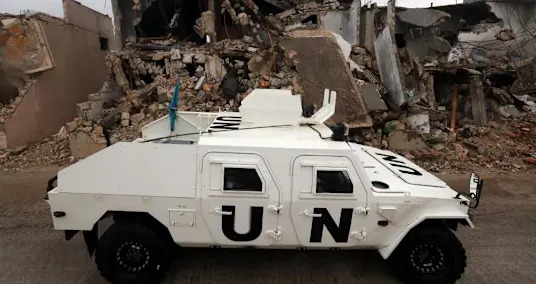
Two Indonesian peacekeepers were killed in southern Lebanon on Monday when an "explosion of unknown origin destroyed their vehicle", the UN agency tasked with policing the region has said.
A third peacekeeper was "severely" injured in the explosion, and a fourth was hurt, the United Nations Interim Force in Lebanon (Unifil) said in a statement.
It is the second fatal incident in the last 24 hours, Unifil noted. A peacekeeper - who was also Indonesian - was killed on Sunday night when a projectile, also of unknown origin, exploded in Adchit Al Qusayr in southern Lebanon.
Unifil said it had launched investigations to determine what happened in both incidents.
The deaths come shortly after the Israeli military announced it would step up ground and air attacks against the Lebanese armed group Hezbollah.
Hezbollah, an Iranian-backed militia as well as a political party, has fired rockets into Israel in retaliation for the ongoing US-Israeli strikes on Iran.
Unifil said of the two deaths on Monday: "We extend our sincerest condolences to the family, friends, and colleagues of those brave peacekeepers who gave their lives in service of peace."
It said under international law, "all actors" had an obligation to ensure the "safety and security" on UN personnel.
"Deliberate attacks" on peacekeepers were "grave violations" of international humanitarian law, Unifil said.
"The human cost of this conflict is far too high. The violence, as we have said before, must end."
Unifil was created by the UN Security Council in 1978, and has since served as a buffer between Israel and Lebanon.
The peacekeeping force patrols the "Blue Line" - the de facto border between Lebanon and Israel, in collaboration with the Lebanese army.
Around 339 peacekeepers have been killed since the mission was established.
Despite a November 2024 ceasefire between Israel and Hezbollah, brokered after violence flared between the two over the war in Gaza, Israel has conducted near-daily strikes on Hezbollah targets.
It says the armed group has not abided by the terms of the ceasefire - under which Hezbollah was meant to disarm and leave its positions in the south - and has accused Unifil and the Lebanese army of not doing enough to remove its militants from the region.
Israel says its latest operation in southern Lebanon was intended to ensure the security of communities in the north.
Since the ceasefire began, 1,238 people have been killed in Lebanon, according to the Lebanese health ministry, including 124 children.
Earlier this month, four Ghanaian soldiers serving with Unifil were injured when their base was hit.
Ghanaian Foreign Minister Samuel Okudzeto Ablakwa did not say who was responsible when speaking at a Commonwealth meeting on Sunday but said the bombing was "an attack on every principle that the UN Charter exists to defend".
latest_posts
- 1
 Tire Brands for Senior Drivers: Guaranteeing Security and Solace
 - 2Wonderful Sea shores All over the Planet
- 3Here's what can happen if you drive under the influence of pot
- 4BioMarin to acquire Amicus Therapeutics for $4.8 billion in rare disease bet
- 5Looking for under-the-radar adventures? Try Norway's Vesterålen



- Iran-backed Iraqi militias attack Kurdistan over 450 times since beginning of war
- Careful Nurturing: Techniques for Bringing up Tough Children
- Saturn shines with the waxing moon at sunset on Nov. 29
- NASA troubleshoots Artemis II toilet problem in otherwise smooth flight
- Instructions to Really Oversee Unsold SUVs in the Auto Business
- Clones of Stumpy, Washington D.C.'s beloved cherry blossom tree, have flowered for the first time
- Allow Innovative Progressions To have a Massive Effect
- This widow influencer is using jokes to cope after her husband's death. It's OK if people don't get it.
- A volcanic eruption may have catalyzed the plague's arrival in Europe, study suggests